Underwrite wildfire risk with spectral property insights.

Underwrite wildfire risk with spectral property insights.

Remotely measure the material composition and parcel-level conditions that drive structural loss, from current defensible space compliance to vegetation moisture to roof material. Our system interrogates spectral signatures within satellite, aerial, and drone imagery to produce dynamic, new-to-the-world risk signals with industry-leading recency. 

Remotely measure the material composition and parcel-level conditions that drive structural loss, from current defensible space compliance to vegetation moisture to roof material. Our system interrogates spectral signatures within satellite, aerial, and drone imagery to produce dynamic, new-to-the-world risk signals with industry-leading recency. 

8M+

8M+

Properties covered at launch
CA & CO

Properties covered at launch
CA & CO

Up to 52%

Up to 52%

Structural loss reduction.

Structural loss reduction.

30%+

30%+

Savings on property inspections.

Savings on property inspections.

Built for mitigation credit compliance.

CA AB 3074 & CO HB25-1182

CA AB 3074 & CO HB25-1182

The Problem

Underwriters can’t see the physical risk
to each home and how it’s changing.

As wildfire risk grows, so does the importance of property-level mitigation and home hardening. But today, underwriters can’t see the physical risk to each home and how it’s changing.

Instead, underwriters must rely on stale property insights or costly in-person inspections. This blind spot results in mispricing of risk, ballooning loss ratios, and additional time and expense to comply with regulations and grant mitigation credits.

The Product

Property Level, Physics-based
Wildfire Risk API

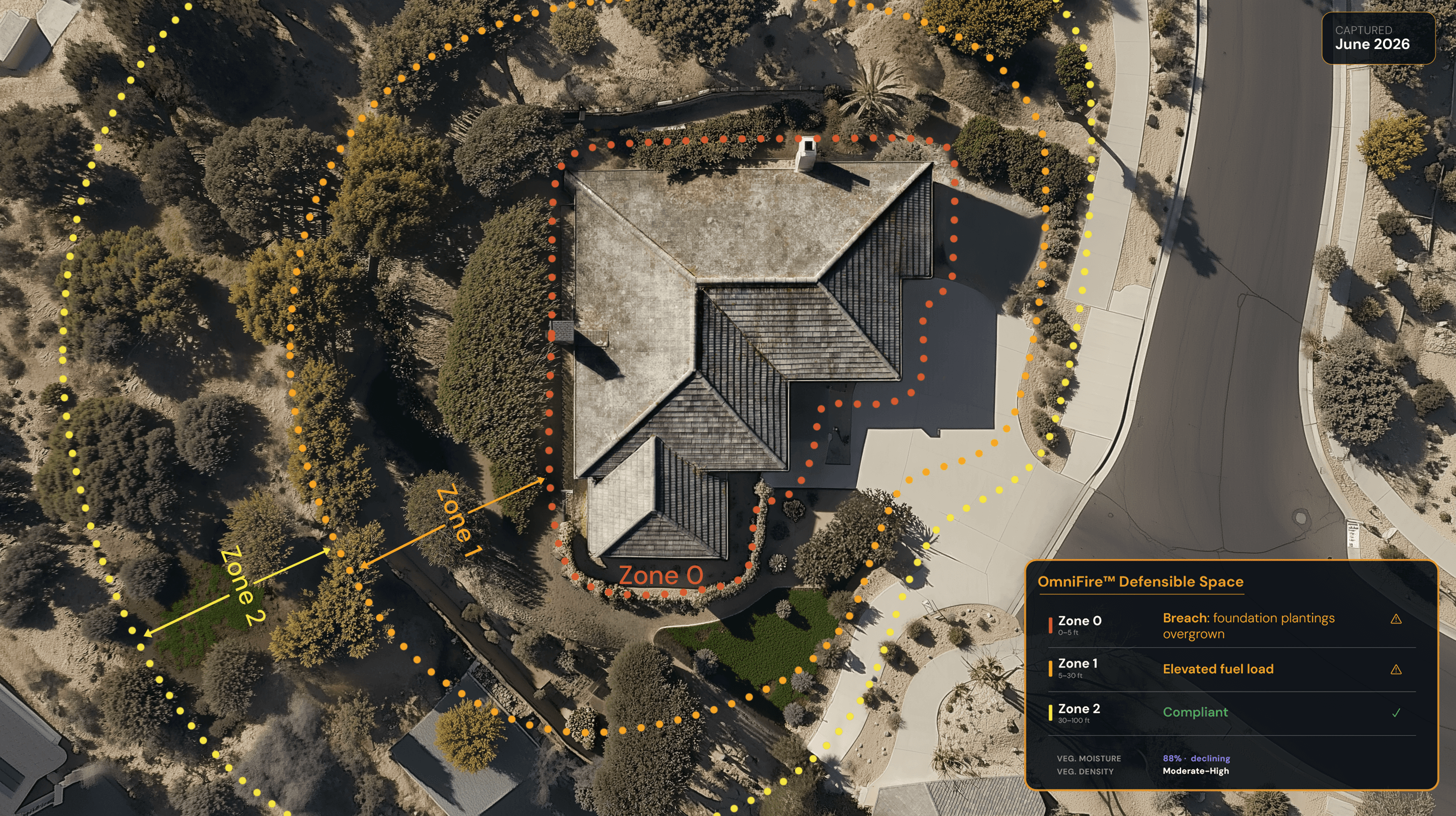
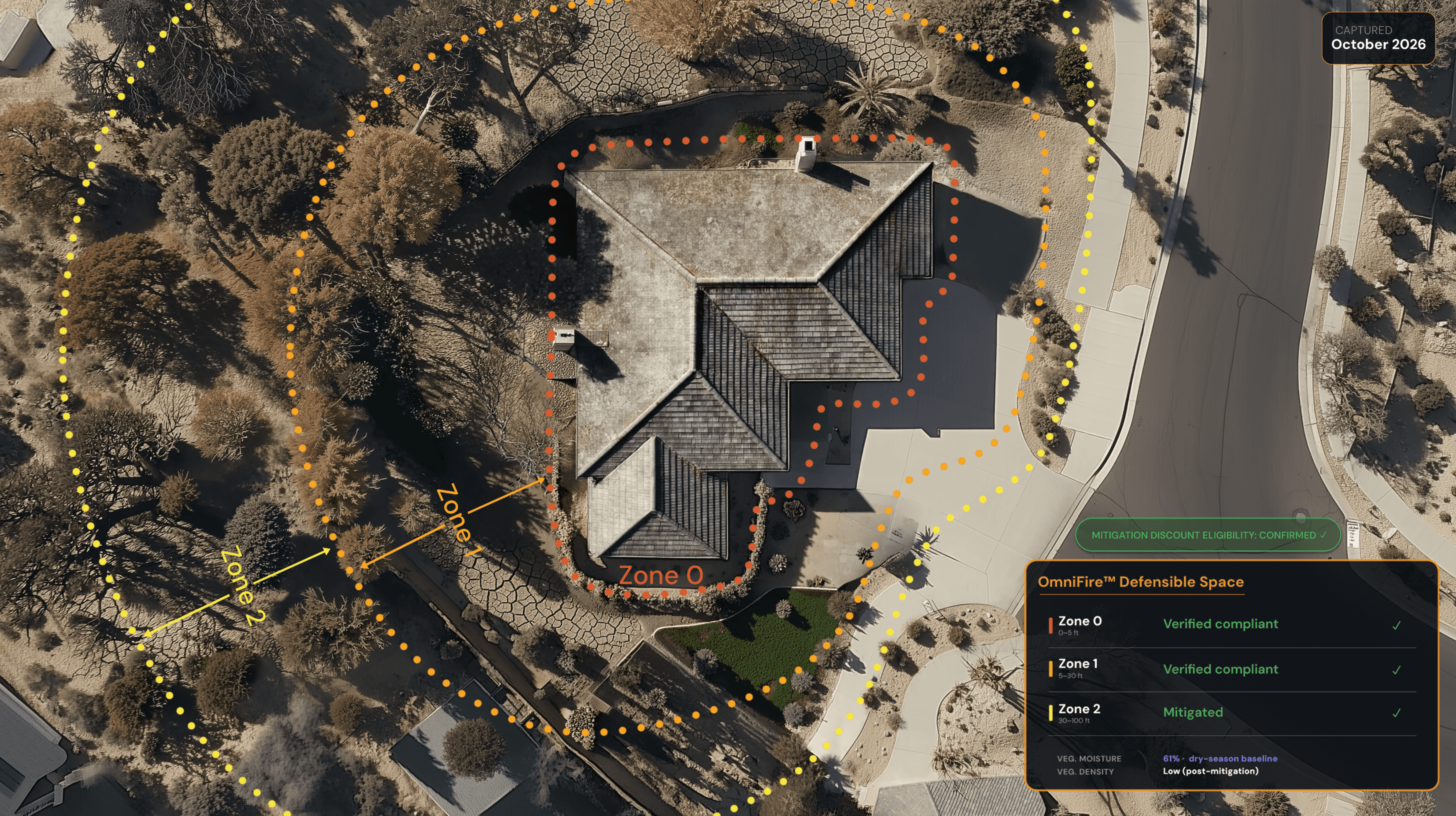
OmniFire allows carriers to remotely assess wildfire risk and mitigation with industry-leading recency. Our novel spectral science approach delivers roof composition, vegetation moisture content, and dynamic defensible space, reflecting actual on-the-ground conditions at the point of quote.

Structure Risk

Structure Risk

Roof condition, roof materials, roof debris, siding and deck materials (require oblique image) and tree overhang.

Roof condition, roof materials, roof debris, siding and deck materials (require oblique image) and tree overhang.

Parcel Risk

Parcel Risk

Defensible space (Zone 0/1/2), vegetation density, vegetation moisture, slope and position on the slope.

Defensible space (Zone 0/1/2), vegetation density, vegetation moisture, slope and position on the slope.

Community Risk

Community Risk

Structure density, ember impact potential, protection class and accessibility.

Structure density, ember impact potential, protection class and accessibility.

Unlock Dynamic Pre- and Post-Mitigation Assessments

Unlock Dynamic Pre- and Post-Mitigation Assessments

OmniFire dynamic risk profiles move as conditions evolve. Establish pre-bind defensible space for accurate underwriting and pricing, then remotely confirm mitigation work post-bind. Renewal notifications flag properties where risk has materially changed.

OmniFire dynamic risk profiles move as conditions evolve. Establish pre-bind defensible space for accurate underwriting and pricing, then remotely confirm mitigation work post-bind. Renewal notifications flag properties where risk has materially changed.

Strengthen Your Book With True Wildfire Vulnerability

Strengthen Your Book With True Wildfire Vulnerability

Using our proprietary spectral intelligence system, we extract hundreds of bands from a broad swath of standard RGB and RGBi imagery—from satellite, aerial, and drone—delivering hyperspectral structural, material, and condition insights that drive wildfire vulnerability at the property level. All in a single API.

Using our proprietary spectral intelligence system, we extract hundreds of bands from a broad swath of standard RGB and RGBi imagery—from satellite, aerial, and drone—delivering hyperspectral structural, material, and condition insights that drive wildfire vulnerability at the property level. All in a single API.

Benefits

Benefits of Spectral Intelligence for Insurance

New-Net Risk Signals

Vegetation. Roofs. Siding. Some materials are more fire-resistant than others. We can tell the difference.

100% Coverage

Verify mitigation and structure conditions from above, at every address, at scale

Best-in-Class Recency

with high refresh rate for accurate risk assessment, pre- and post-mitigation validation, and a reduction of costly homeowner objections.

Stay Compliant

with CA AB 3074 and CO HB25-1182 - auditable, explainable property-level signals.

Reduce Structural Loss

by up to 52% - underwrite on measured conditions, not modeled estimates (Nature Communications, 2025).

Scalability & Growth

AI adapts to your business needs, allowing you to scale efficiently without increasing workload or costs.

Proof

Over 50% of wildfire-incurred structural loss may be preventable.

A peer-reviewed study analyzing thousands of homes destroyed across five major California wildfires found that home hardening and defensible space could reduce structural loss by up to 52%. The implication is significant: the majority of wildfire losses are not acts of nature. They are functions of measurable, addressable property conditions.

Source: Nature Communications, 2025. Analysis of Tubbs, Thomas, Camp, Kincade, and Glass fires.

Source: Nature Communications, 2025. Analysis of Tubbs, Thomas, Camp, Kincade, and Glass fires.

Proof

Over 50% of wildfire-incurred structural loss may be preventable.

A peer-reviewed study analyzing thousands of homes destroyed across five major California wildfires found that home hardening and defensible space could reduce structural loss by up to 52%. The implication is significant: the majority of wildfire losses are not acts of nature. They are functions of measurable, addressable property conditions.

Source: Nature Communications, 2025. Analysis of Tubbs, Thomas, Camp, Kincade, and Glass fires.

The regulations are here. Are your underwriters ready?

Regulatory Readiness

California and Colorado have moved from guidance to mandate, while Oregon and Washington are drafting similar legislation. OmniFire signals conform to the property-level assessment, mitigation discount, and disclosure requirements in both bills.

CA AB 3074

Fire Prevention: Defensible Space & Ember-Resistant Zones

Mandates a five-foot ember-resistant Zone Zero around all structures, in addition to existing Zone 1 (5–30ft) and Zone 2 (30–100ft) defensible space requirements. Carriers must document physical compliance - not estimated conditions - at underwriting and renewal.

Signed: 2025

In effect: 2026 (existing structures)

Applies to: All structures in Fire Hazard Severity Zones

Zone 0–3 defensible space scoring

Mitigation discount eligibility signal

Physically verified audit package

Renewal change notifications

Signed: 2025

In effect: 2026 (existing structures)

Applies to: All structures in Fire Hazard Severity Zones

Zone 0–3 defensible space scoring

Mitigation discount eligibility signal

Physically verified audit package

Renewal change notifications

CO HB25-1182

Risk Model Use in Property Insurance Policies

Requires insurers to incorporate property-specific mitigation - defensible space, structure hardening, mitigation certification - into underwriting and pricing. Annual written disclosure of wildfire risk score and available mitigation discounts to every policyholder. Policyholders have the right to appeal their score.

Signed: 2025

In effect: July, 2026

Applies to: All property insurers using wildfire risk models or scoring methods

Property-specific mitigation signal

Annual policyholder disclosure report

Mitigation discount eligibility signal

Appeal-ready audit trail

FAQs

Questions?

How is OmniFire different from existing wildfire risk insights and scores?

How current is the imagery and how often are signals updated?

How does OmniFire map to CA AB 3074 and CO HB25-1182 compliance requirements specifically?

We already use aerial imagery. What does OmniFire add?

What is OmniGeo?

OmniGeo © 2026

OmniGeo © 2026